

Excelsior Correspondent
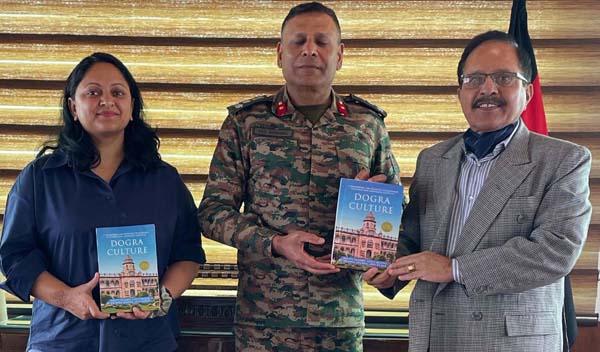
SRINAGAR, Apr 20: A new book titled “Dogra Culture – A Framework for Revival of Endangered Cultures and Languages Globally” was released today by Brigadier Ved Beniwal, Commandant, Jammu and Kashmir Light Infantry (JAK LI) Regimental Centre, Srinagar.
As per a statement, the book has been co-authored by Major General S K Sharma, AVSM (Retd), and Deepti Sharma, a Global Career Counsellor (UCLA, USA).
The statement said the book traces the roots of Dogra heritage and provides a framework for the revival of nearly 3,000 endangered cultures across the world, including over 190 in India.
Besides, the book explores the Dogras’ lineage, connecting them to the Suryavanshi dynasty, it said.
It also mentions Agniveer, believed to be the 21st descendant of Lord Ram, as the first known Dogra ruler.
The book also outlines various Dogra dynasties including the Rai (50 BCE-430 CE), Dhar (430-840 CE), and Dev (920-1780 CE) dynasties.
Special focus has been given to the reign of Maharaja Gulab Singh (1822-1856), and the subsequent rule of Maharajas Ranbir Singh, Pratap Singh, and Hari Singh till 1947.
Speaking at the event, Brigadier Beniwal recalled the 1947 invasion of Jammu and Kashmir by Pakistan-backed raiders.
He said the people of Jammu, Poonch, Leh, and other areas fought back valiantly by forming scout groups. These groups were later converted into battalions under the name J&K Militia, which became JAK LI in 1976.
He praised JAK LI for its inclusive spirit and heroic service, including the valour of Subedar Bana Singh, who was awarded the Param Vir Chakra during the Siachen conflict.
Maj Gen Sharma said that Dogra culture saw a decline post-1947, but efforts by the community led to its recognition, with 26 lakh Dogras recorded in the 2011 Census.
He expressed hope that this book will serve as a valuable guide for policymakers worldwide in preserving endangered cultures.
 Follow our WhatsApp channel
