

B S Dara
bsdara@gmail.com
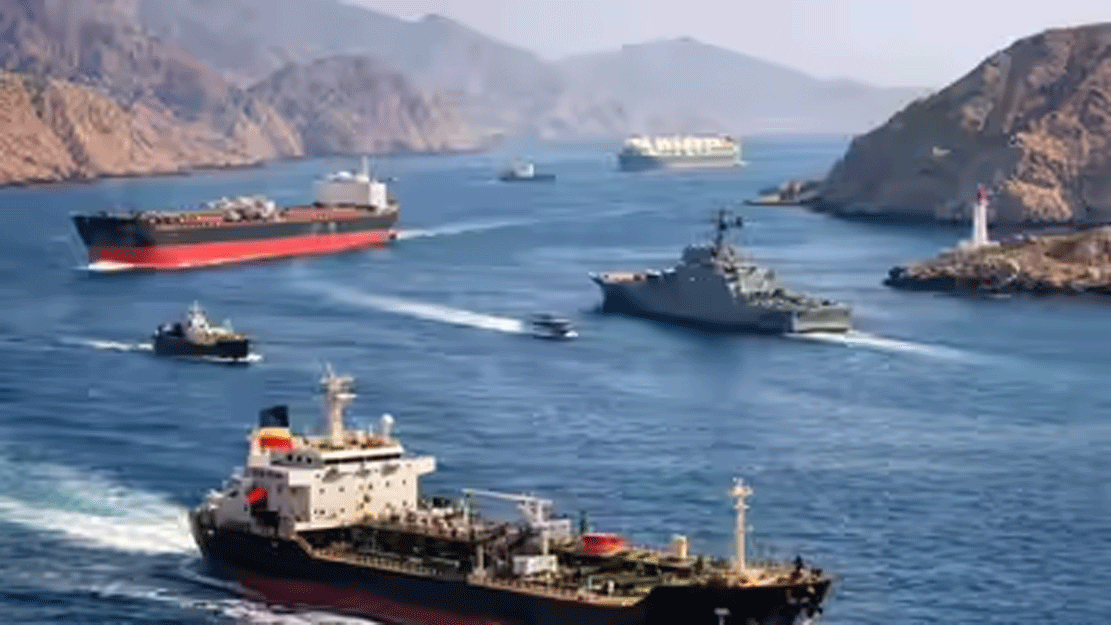
The Strait of Hormuz, through which a fifth of the world’s oil flows, explains why even superpowers tread carefully in confronting Tehran.
In the calculus of modern warfare, military strength is usually judged by the weapons deployed and the armies assembled. Analysts count missiles, fighter jets, and naval fleets to determine who holds the advantage. Yet in the current confrontation involving Iran and Western powers, the most powerful factor shaping the conflict is neither technological superiority nor military firepower. It is geography.
Along Iran’s southern coastline runs one of the most strategically consequential waterways on earth: the Strait of Hormuz. This narrow maritime passage, located between Iran and the Arabian Peninsula, connects the oil-rich Persian Gulf to the open waters of the Arabian Sea and beyond. Every day, vast quantities of oil and liquefied natural gas move through this corridor toward global markets. The numbers alone reveal the scale of its importance. Approximately 20 percent of the world’s oil supply passes through the Strait of Hormuz, making it the single most significant oil chokepoint in the global energy system. For many Asian economies, including China, India, Japan, and South Korea, this route represents the primary artery through which their energy lifelines flow. In such a system, geography can confer extraordinary influence. And that is precisely the strategic reality shaping the current war.
The Strait of Hormuz is remarkably small for the role it plays in the global economy. At its narrowest navigational point, the shipping lanes through the strait are only a few kilometers wide in each direction. Yet through this confined channel flows an enormous share of the world’s energy trade.
Oil from Saudi Arabia, Iraq, Kuwait, the United Arab Emirates, and Qatar must pass through this corridor before reaching international markets. Tankers loaded in Gulf terminals travel through Hormuz before heading toward Asia, Europe, and other destinations. Because of this concentration of energy traffic, even minor disruptions in the region can cause immediate turbulence in global markets. Traders respond rapidly to geopolitical developments in the Gulf, often pushing oil prices upward whenever tensions rise. Energy markets operate on expectations as much as on physical supply. The mere possibility of disruption in Hormuz can send shockwaves through oil and gas prices worldwide.
Iran’s conventional military capabilities are frequently compared unfavorably with those of the United States and its allies. Western powers maintain superior air forces, advanced naval fleets, and sophisticated intelligence networks.
However, Iran has developed a military strategy specifically designed to exploit the geography of the Persian Gulf. Instead of competing directly with larger navies, Iran has invested heavily in asymmetric maritime capabilities, tools that are particularly effective in narrow waterways. These include Coastal anti-ship missile systems. Naval mines capable of disrupting shipping routes. Swarms of fast attack boats. Armed drones and surveillance platforms
In the confined environment of the Strait of Hormuz, such systems can pose significant challenges for large naval vessels and commercial shipping alike. Iran does not need to permanently close the strait to exert pressure. Even temporary disruptions, such as harassment of tankers, threats to shipping lanes, or the placement of naval mines, can dramatically increase insurance costs and delay cargo shipments.
In a global economy where supply chains operate with tight margins and precise timing, even small interruptions can have disproportionate effects. Some observers suggest that global oil markets could bypass the Strait of Hormuz through alternative routes. In theory, pipelines and other maritime corridors could reduce dependence on the strait. In practice, however, such alternatives remain limited.
Saudi Arabia operates an east-west pipeline that transports crude from the Persian Gulf to ports on the Red Sea. The United Arab Emirates also maintains a pipeline that allows some oil exports to bypass Hormuz via the port of Fujairah.
Yet these routes together can only carry a fraction of the oil volume that normally passes through the strait. Much of the region’s energy infrastructure was built around Gulf terminals and tanker routes converging on Hormuz. Countries such as Iraq, Kuwait, and Qatar remain heavily dependent on the strait for their exports. For them, there is simply no large-scale alternative pathway to global markets. The strategic significance of the Strait of Hormuz explains why even powerful nations approach the current conflict carefully.
For the United States, maintaining the free flow of energy through the Gulf has long been a central pillar of foreign policy. American naval forces have maintained a continuous presence in the region for decades to ensure that shipping lanes remain open. However, direct confrontation with Iran carries risks that extend beyond the battlefield. A prolonged conflict that disrupts Hormuz could trigger a major global energy crisis, pushing oil prices sharply upward and destabilizing economies around the world.
China faces similar concerns. As the world’s largest importer of crude oil, Beijing relies heavily on shipments from the Persian Gulf. Any disruption to these flows would immediately affect China’s industrial output and economic growth.
India, another rapidly growing energy consumer, depends on stable supplies from Gulf producers. For New Delhi, the Strait of Hormuz represents a vital gateway to energy security. Because of these interdependencies, major powers often balance military pressure with diplomatic caution.
Iran’s Strategic Deterrent
While Iran’s geographic position gives it leverage, it also imposes constraints. A full closure of the Strait of Hormuz would harm Iran itself. The country relies on the same shipping routes to export its own oil and maintain economic activity. Moreover, a sustained blockade would likely provoke an international military response aimed at reopening the waterway. Global energy security is too important for the world’s major economies to allow the strait to remain closed indefinitely. For this reason, analysts generally view Iran’s strategy as one of deterrence rather than permanent disruption. The ability to threaten the strait can shape negotiations and influence geopolitical calculations without requiring its actual closure.
In other words, Iran’s geographic advantage functions more as a strategic bargaining chip than as a weapon to be used outright. The continuing importance of the Strait of Hormuz highlights a broader truth about global politics: geography still matters. In an era dominated by advanced technology and global connectivity, physical location continues to shape the balance of power. Natural chokepoints, whether canals, straits, or narrow sea lanes, remain central to the functioning of the global economy.
The Persian Gulf represents one of the most prominent examples of this reality. Every day, tankers carrying millions of barrels of oil navigate the narrow waters of Hormuz. Behind each shipment lies a chain of economic activity, from electricity generation and industrial production to transportation networks and consumer goods. Any disruption to this system would reverberate across continents.
The Strait of Hormuz is often described as the artery of the global oil system. Like an artery in the human body, it carries the lifeblood that sustains the wider system. If that artery becomes constricted, the consequences are felt everywhere. That is why even in times of war, global powers tread carefully around the Persian Gulf. Military decisions in the region must account not only for strategic objectives but also for the economic stability of the world. Iran’s influence in the current conflict therefore derives less from its missiles or naval fleets than from the geographic reality of its coastline. As long as the world’s energy supply continues to flow through the Strait of Hormuz, Iran will possess a form of strategic leverage that few countries can match.
In the end, the lesson of the crisis is clear: The weapons of modern war may evolve, but geography remains the most enduring form of power.
(The author is an independent foreign affairs analyst )
 Follow our WhatsApp channel
