

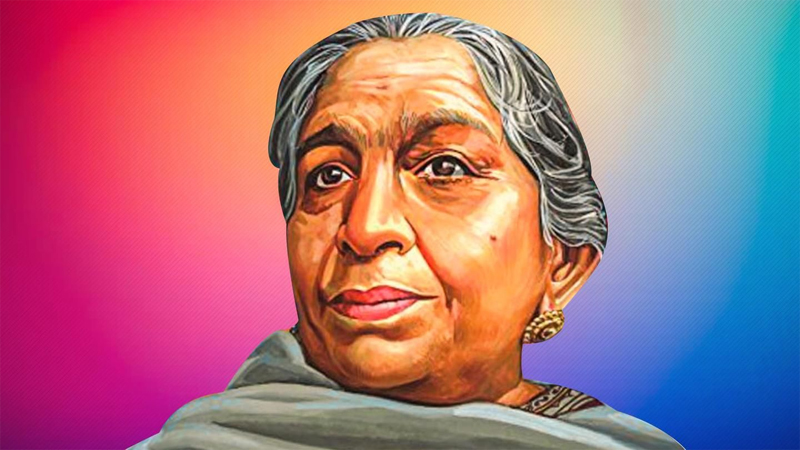
“To wake the dawn and call the morn,” wrote Sarojini Naidu, encapsulating India’s spirit in her evocative poetry. Born on February 13, 1879, Naidu was more than just the “Nightingale of India”-she was a passionate freedom fighter, gifted orator, and tireless social reformer. Her life exemplifies the power of words, unwavering patriotism, and the courage to champion social justice.
Early Life and Education:
Born in Hyderabad, Sarojini was the daughter of Aghorenath Chattopadhyay, principal of Nizam’s College. Educated at home, she excelled in mathematics and science before joining Madras University at twelve. Scholarships from the Nizam of Hyderabad enabled her to study at King’s College, London, and Girton College, Cambridge. These formative years exposed her to feminist and nationalist movements, profoundly shaping her vision for India.
Role in the Freedom Struggle:
Returning to India in 1898, Naidu joined the Indian National Congress, quickly rising to prominence. In 1925, she became the first woman President of the Congress, a historic achievement. A staunch advocate for independence, she participated in pivotal movements like the Non-Cooperation Movement (1920), the Salt Satyagraha (1930), and the Quit India Movement (1942), often facing imprisonment alongside leaders like Mahatma Gandhi. Her powerful speeches ignited patriotic fervor, mobilizing support for the freedom struggle. “I am not ready to die because it requires infinitely higher courage to live,” she declared, demonstrating her commitment to a free India.
Literary Legacy:
Naidu’s literary career blossomed with “The Golden Threshold” (1905). Influenced by her mother, a poet and musician, she began writing at a young age. Her poetry, marked by lyrical beauty, rich imagery, and musicality, earned her the title “Nightingale of India.” Poems like “The Palanquin Bearers” and “In the Bazaars of Hyderabad” vividly depicted Indian life. Her work showcased her mastery of English while expressing Indian identity during the struggle for independence. Lines like “Life is a dome of many-coloured glass,” from “The Feather of the Dawn,” revealed her profound understanding of the human condition.
Champion of Social Reform:
Naidu co-founded the Women’s Indian Association (WIA) in 1917, championing women’s education, health, and legal rights, and playing a crucial role in the fight for women’s suffrage. A vocal critic of social evils like child marriage, untouchability, and the caste system, she actively campaigned against these practices, using her powerful oratory and writings to raise awareness. She passionately argued against child marriage, recognizing its detrimental impact on young girls and the nation’s progress. Her commitment to social justice was integral to her vision of a free and equitable India.
Conclusion:
Sarojini Naidu’s contributions resonate even today. As India strives for holistic development, her ideals remind us of the transformative power of education and the importance of social justice. Her life was a symphony of word and action, a melody that continues to inspire, urging India towards a brighter future. Her legacy is not just history, but a timeless lesson in courage, resilience, and the profound impact one individual can have.
 Follow our WhatsApp channel
